

The intercontinental internet flows through a handful of glass strands under the sea, each about the thickness of a human hair. They carry much of the world’s economy. How?
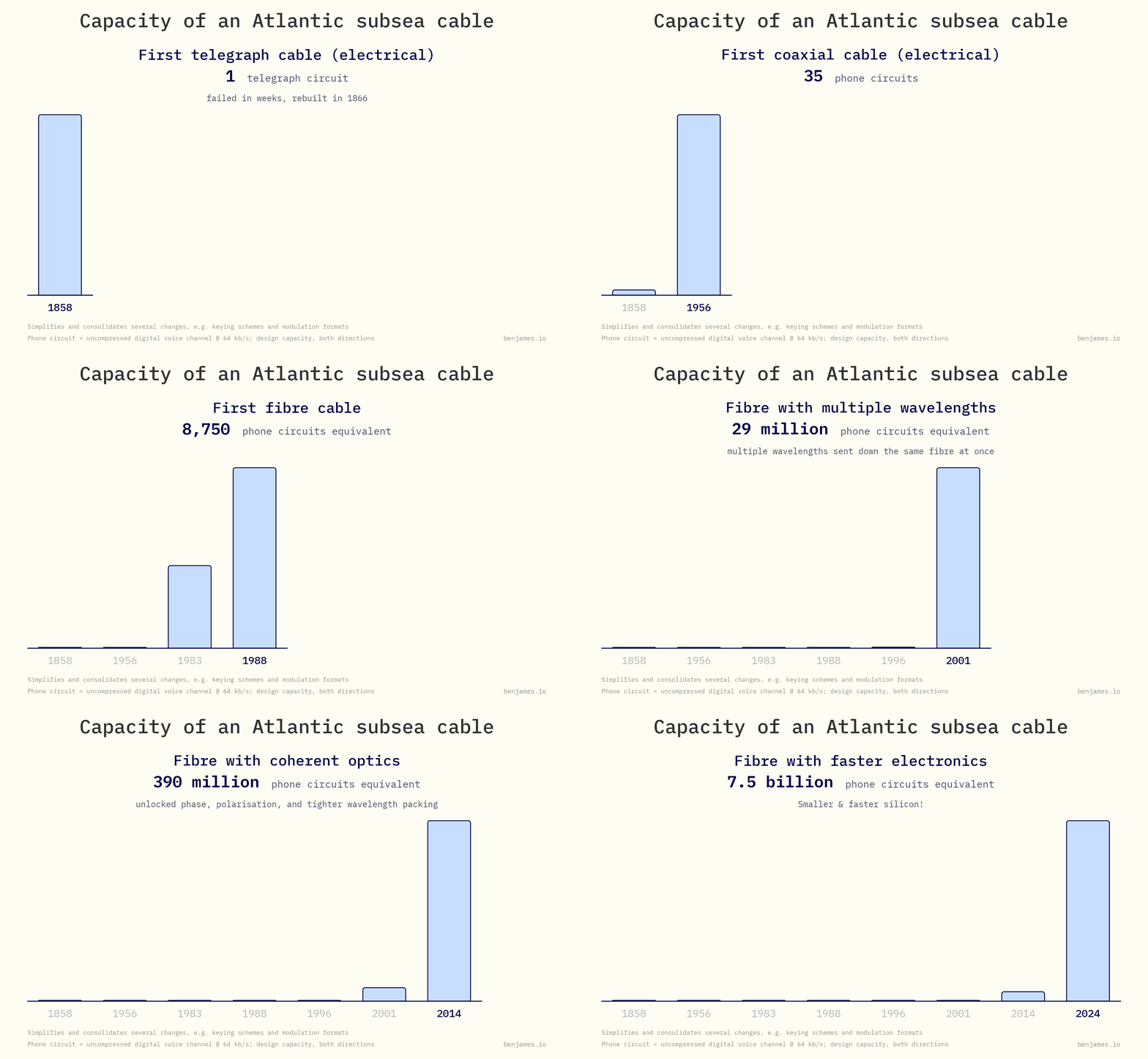
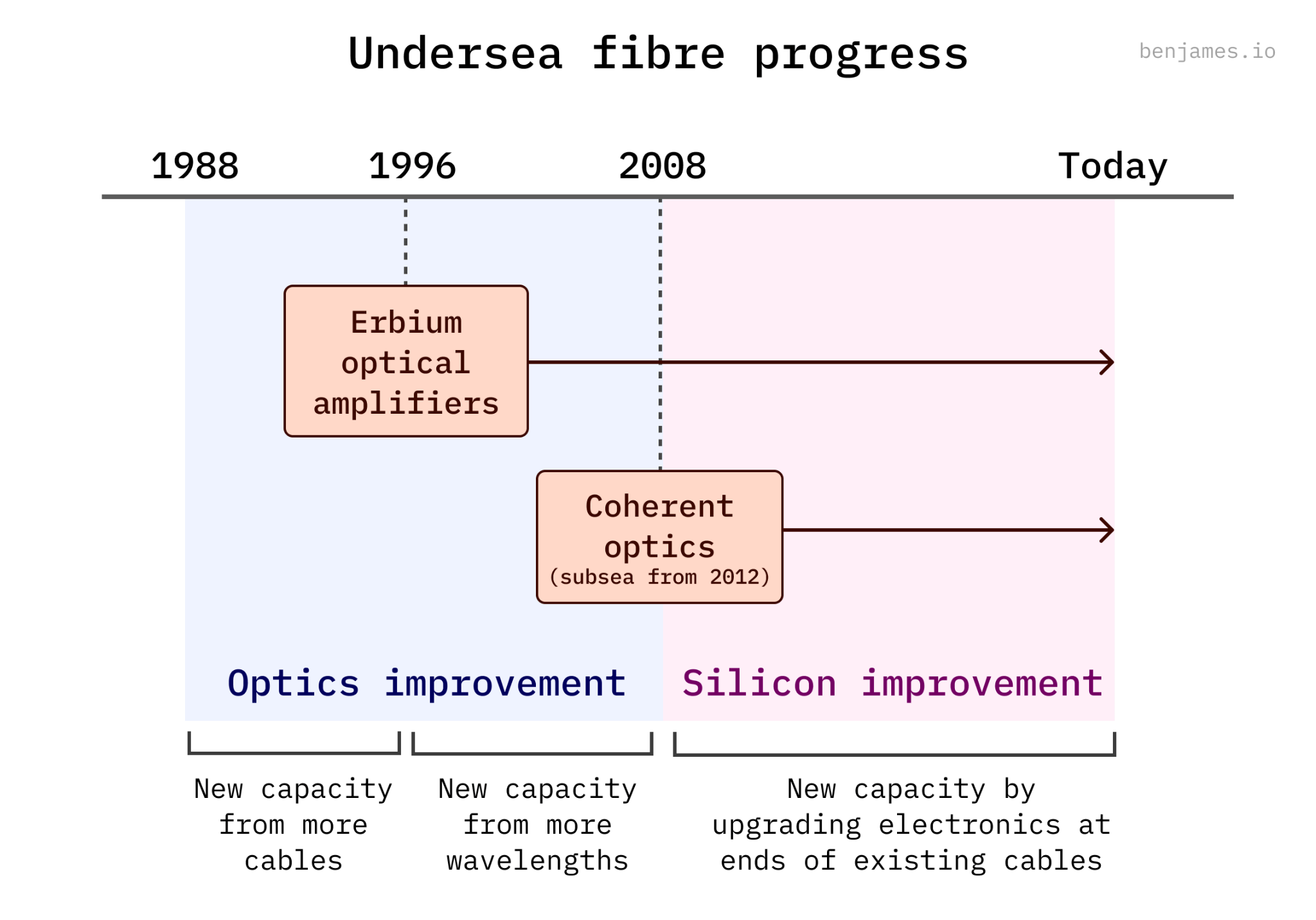
This post will walk through the evolution of subsea cables, as shown here.
Before fibre
In 1858, the first subsea electrical cable was laid across the Atlantic, stretching from Ireland to Newfoundland. The first telegraph it relayed was from Queen Victoria to US President James Buchanan.
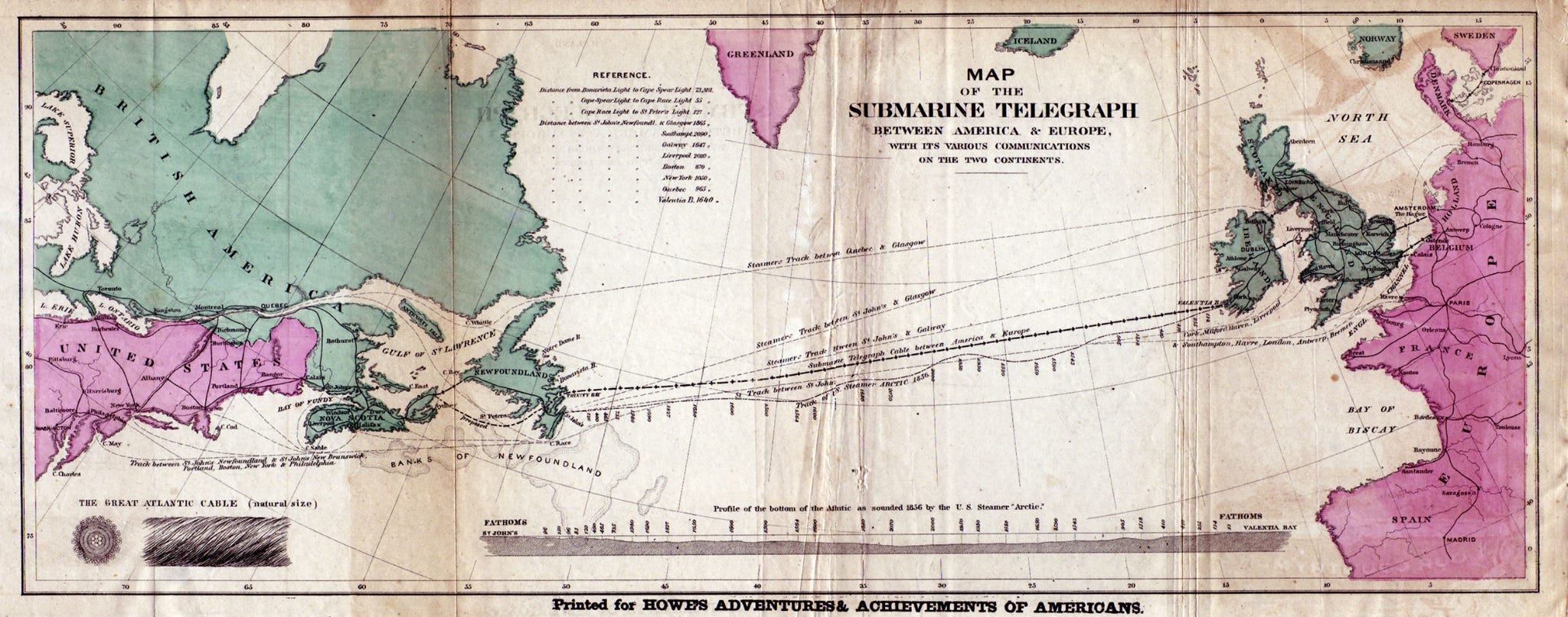
But the cable had terrible signal quality and could only carry telegraphs, not voice. The voltage was increased in an attempt to improve speed, but this destroyed the cable only three weeks into operation.
A second cable was attempted in 1865 but broke in the middle of the voyage. A third, successful cable was laid in 1866. It was carried by the SS Great Eastern, the biggest ship in the world for more than 30 years.
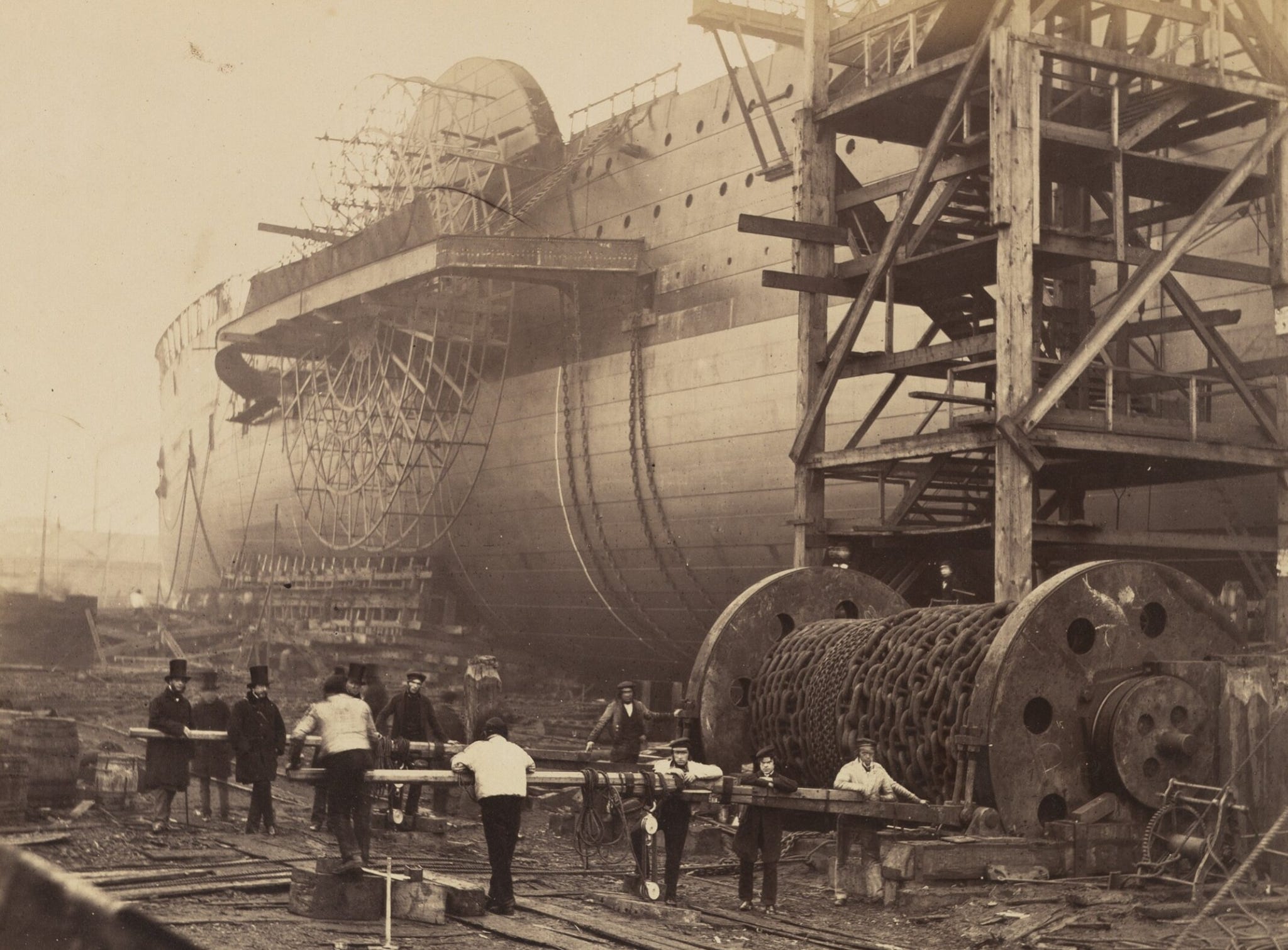
The 1866 cable was still slow (less than 20 words per minute), but for the first time, the US and Europe could reliably communicate without a two week sea voyage.
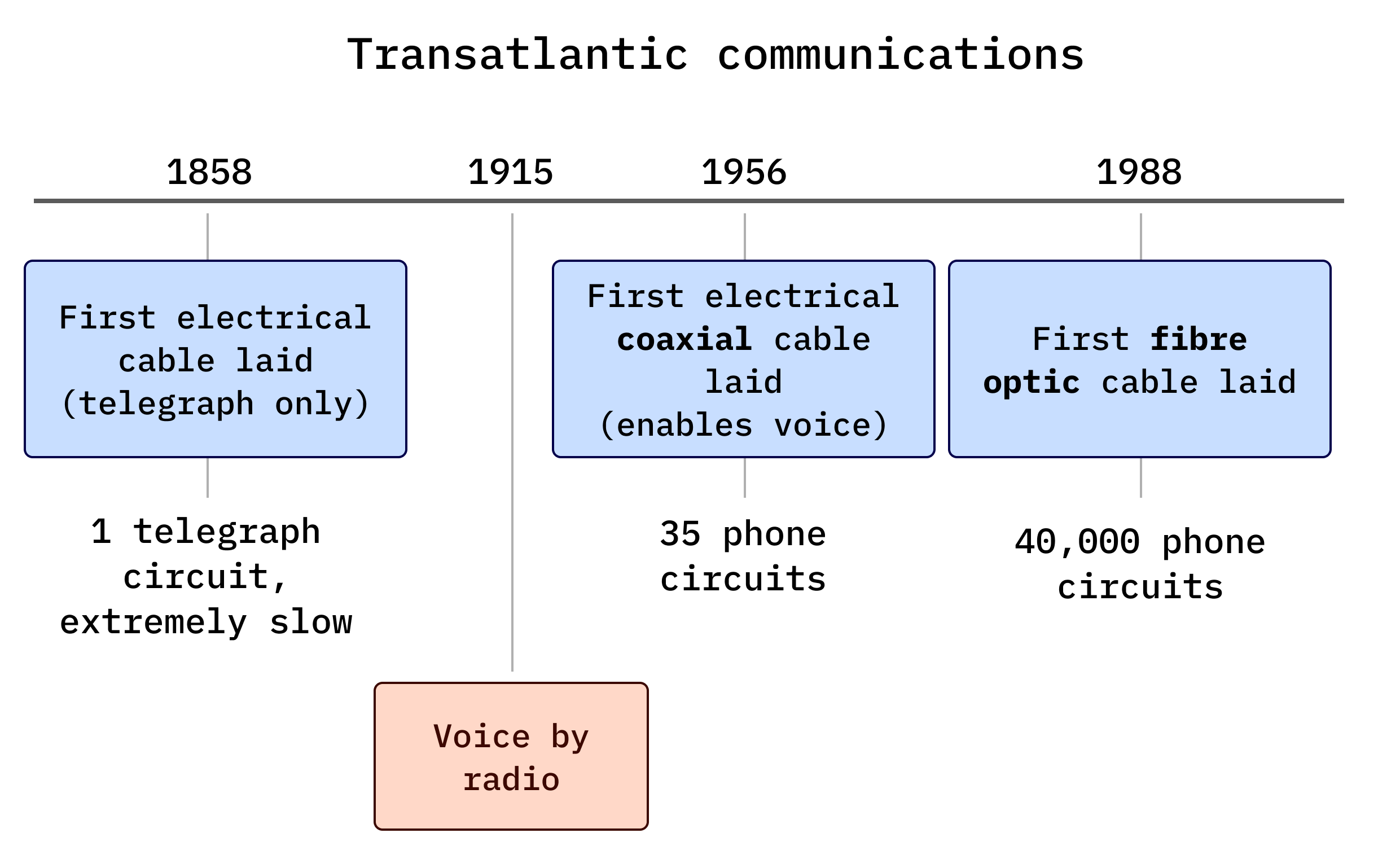
It wasn’t until after the second world war that a phone call crossed the Atlantic in an undersea cable. Three engineering breakthroughs meant that the 1956 cable could carry high enough frequencies to transport the human voice.
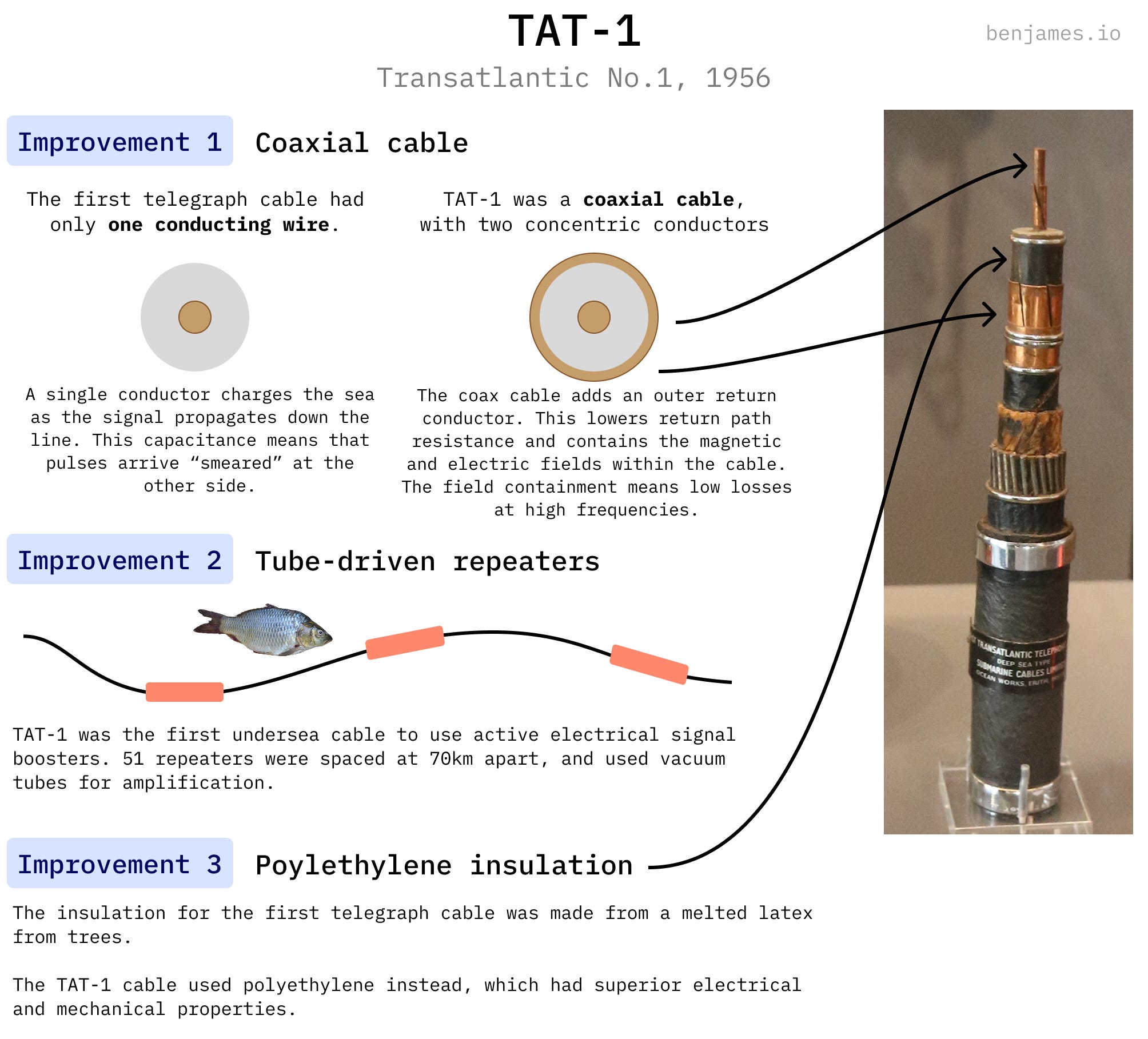
Shoutout Oliver Heaviside, who patented the coaxial cable and developed the Telegrapher’s equations, which describe how signals propagate along a cable. He was, imo, one of the best to ever do it.
TAT-1 could carry 35 phone calls at once, plus some telegraph circuits. After the Cuban missile crisis in 1962, it kept a permanently reserved frequency band for the “red telephone” hotline between Moscow and Washington (which was a telegraph, not a voice line, to avoid misinterpretation).
The fibre age
After the success of TAT-1, they laid 8 more coaxial cables, which got better every time. But they were reaching the limits of copper.
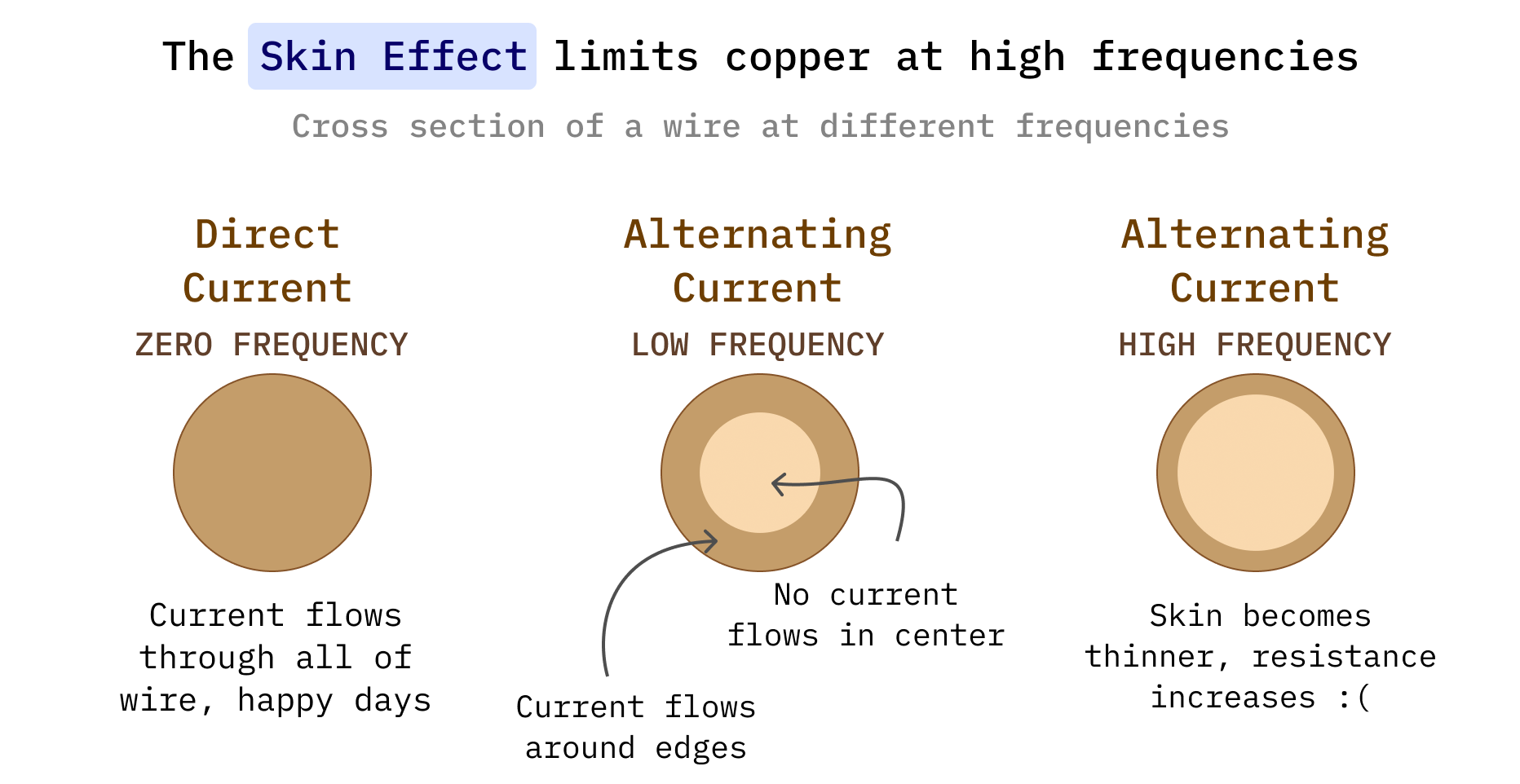
Copper cables are limited by the skin effect. The faster you send data through a metal wire, the greater its resistance to that data becomes. Glass fibre does not suffer from this problem.
So in 1988, they laid TAT-8, the first Atlantic fibre optic cable.
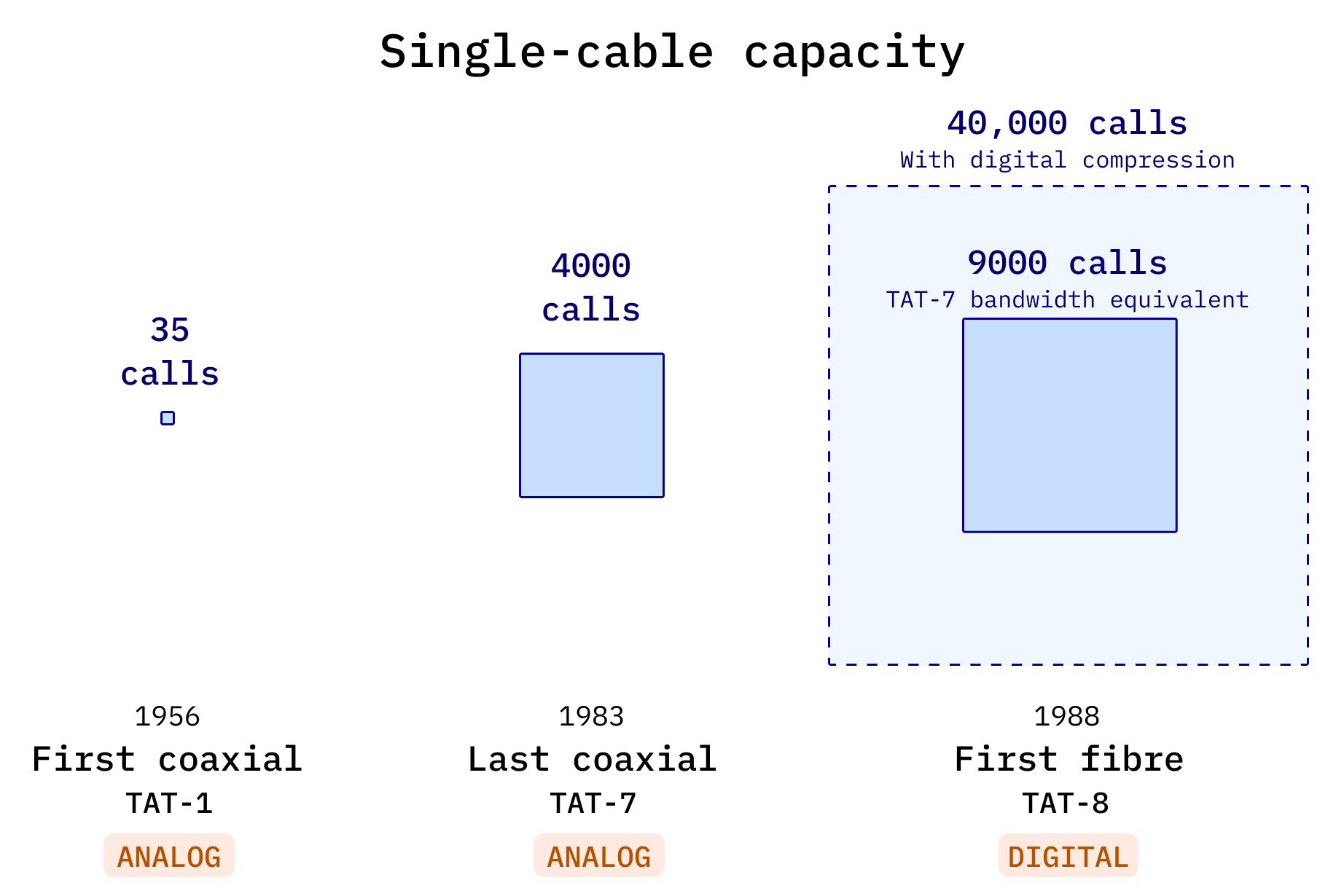
At the time, TAT-8 was a ~10x improvement in useful capacity - though this was mostly due to digital compression, not the fibre itself. But compared to today’s fibre, it was really slow! TAT-8 was over 500,000x slower than a modern subsea cable.
How fibre got quick
An optical fibre transmits 1s and 0s. So you’d think the laser would just turn on and off.
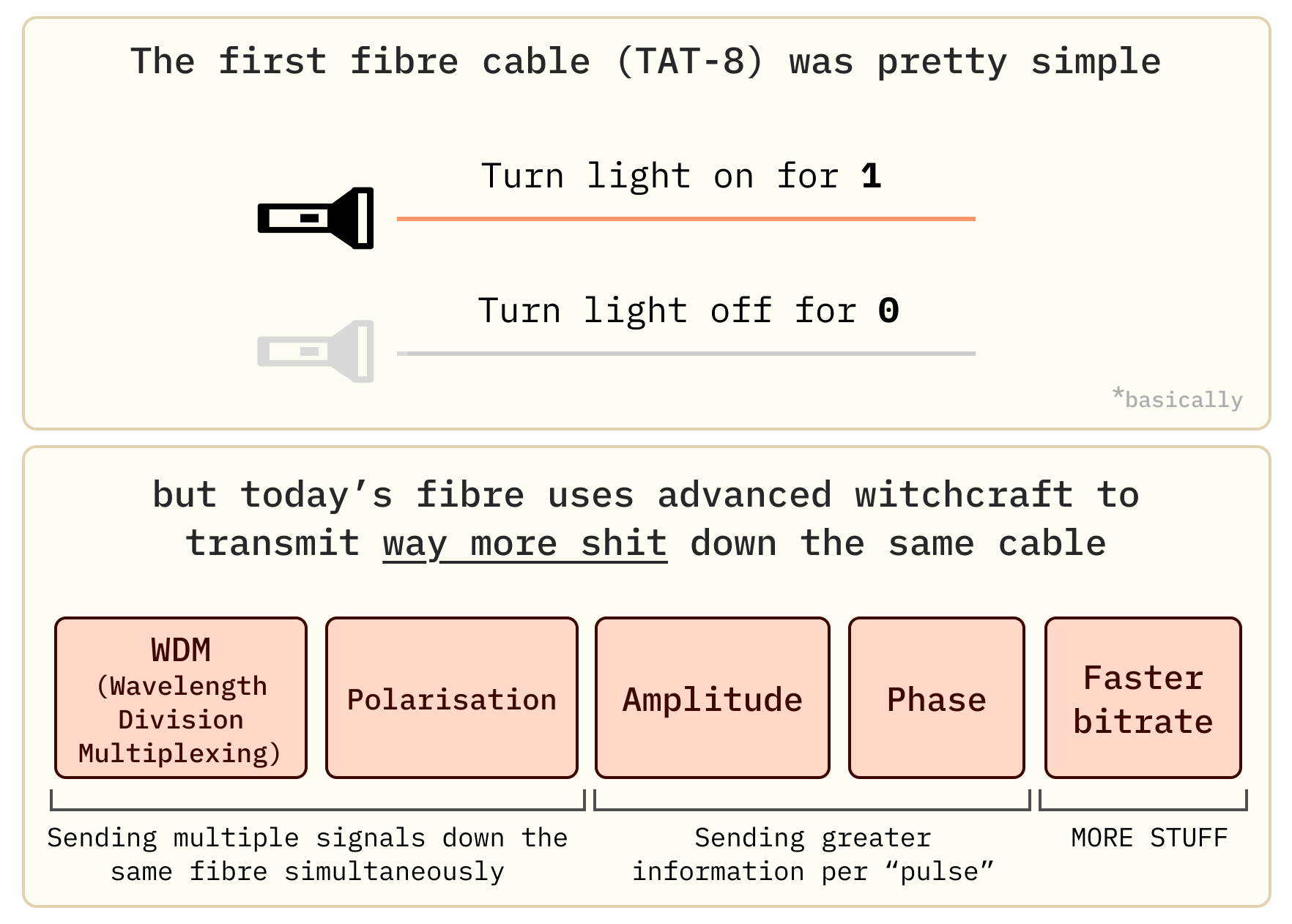
We’ll go through these techniques one by one.
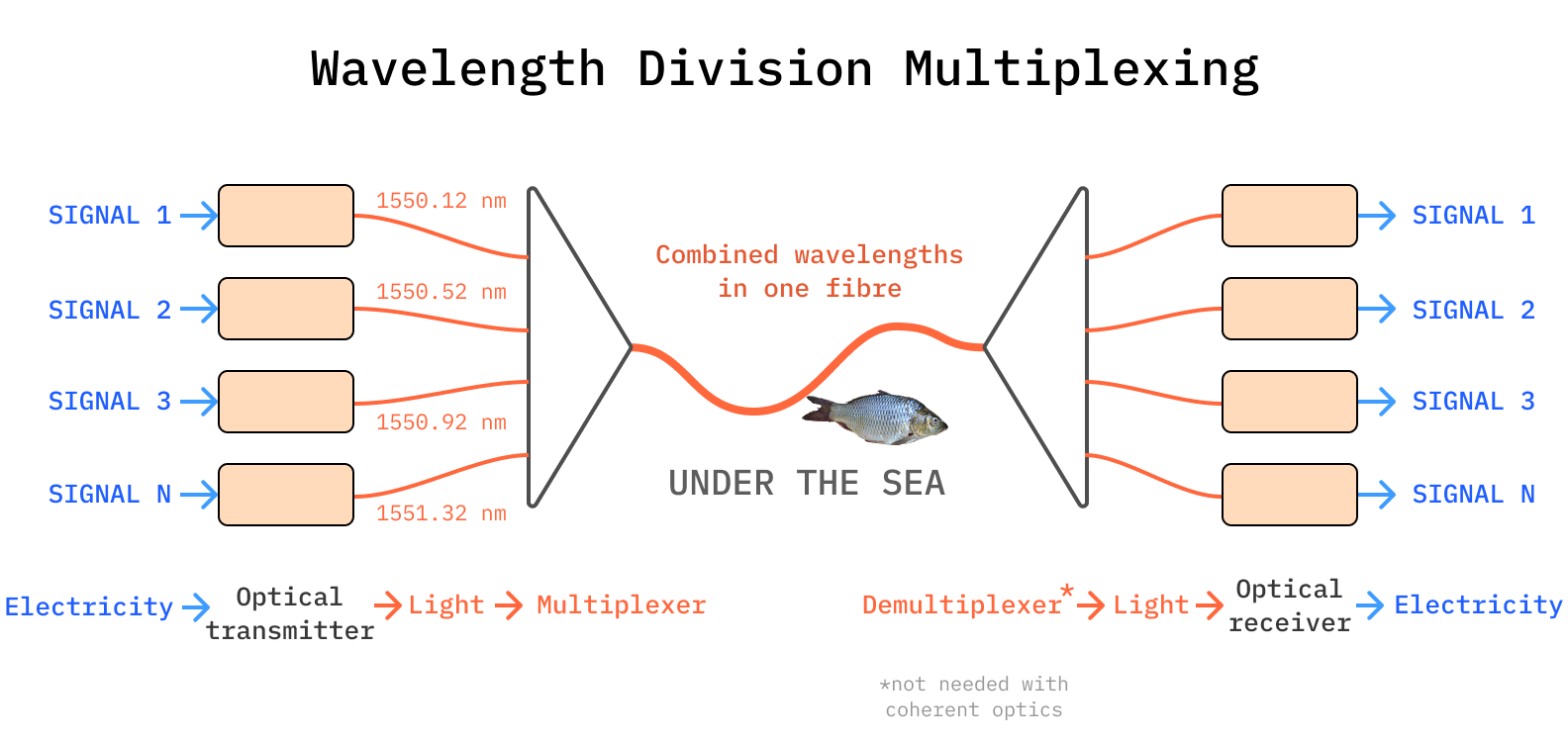
The first is called Wavelength Division Multiplexing. WDM is a way to send multiple signals down the same fibre at once, by splitting them into different frequencies (wavelengths). This is similar to radio broadcasting, but instead of tuning into a frequency band of radio waves in the air, you tune to a particular colour band of laser light. A modern undersea cable can carry on the order of a hundred frequencies simultaneously.
We can also send two signals of the same wavelength down the same fibre at once, by sending them at different polarisations. A horizontally and vertically polarised signal will mix within the cable, but our electronics are now good enough that we can disentangle them. So polarisation doubles the capacity per wavelength.
The second category of trick comes from expanding the vocabulary of our light. Instead of simply turning the light on and off, we can vary its qualities to encode richer data.
At any given moment, our light has an amplitude (how strong it is) and a phase shift (how delayed it is in time). By varying these attributes, each moment of transmission can represent a broader range of information.
This technique is often called keying. Here we show a keying scheme of eight states, made from two amplitudes and four phases.
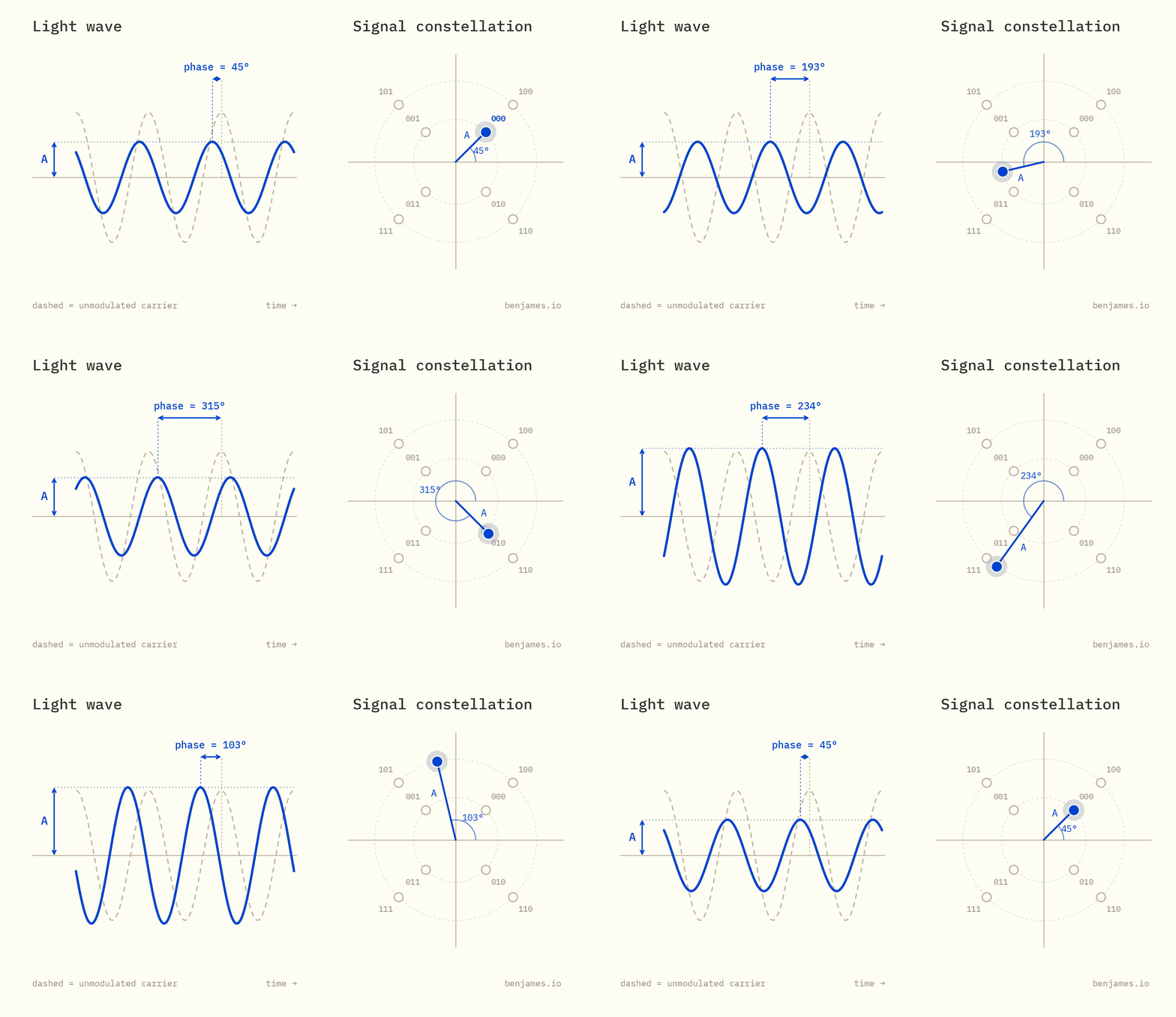
This animation uses eight possibilities, but in shorter cables that run over land, it’s not uncommon to have constellations of 64 or even 256 points.
All of these tricks were well known when the first fibre cable was laid. But it took a long time for us to understand how to implement them in subsea fibre. In particular, wavelength division multiplexing and phase-shift keying only became possible after two new developments: coherent optics and optical repeaters.
Optical amplifiers
The first fibre cable used electrical repeaters. These were simple to design, but lost all of the nuanced information about the light (like phase and polarisation).
Luckily we invented the Erbium-Doped Fibre Amplifier (EDFA), which amplifies light without needing to turn it into electricity.
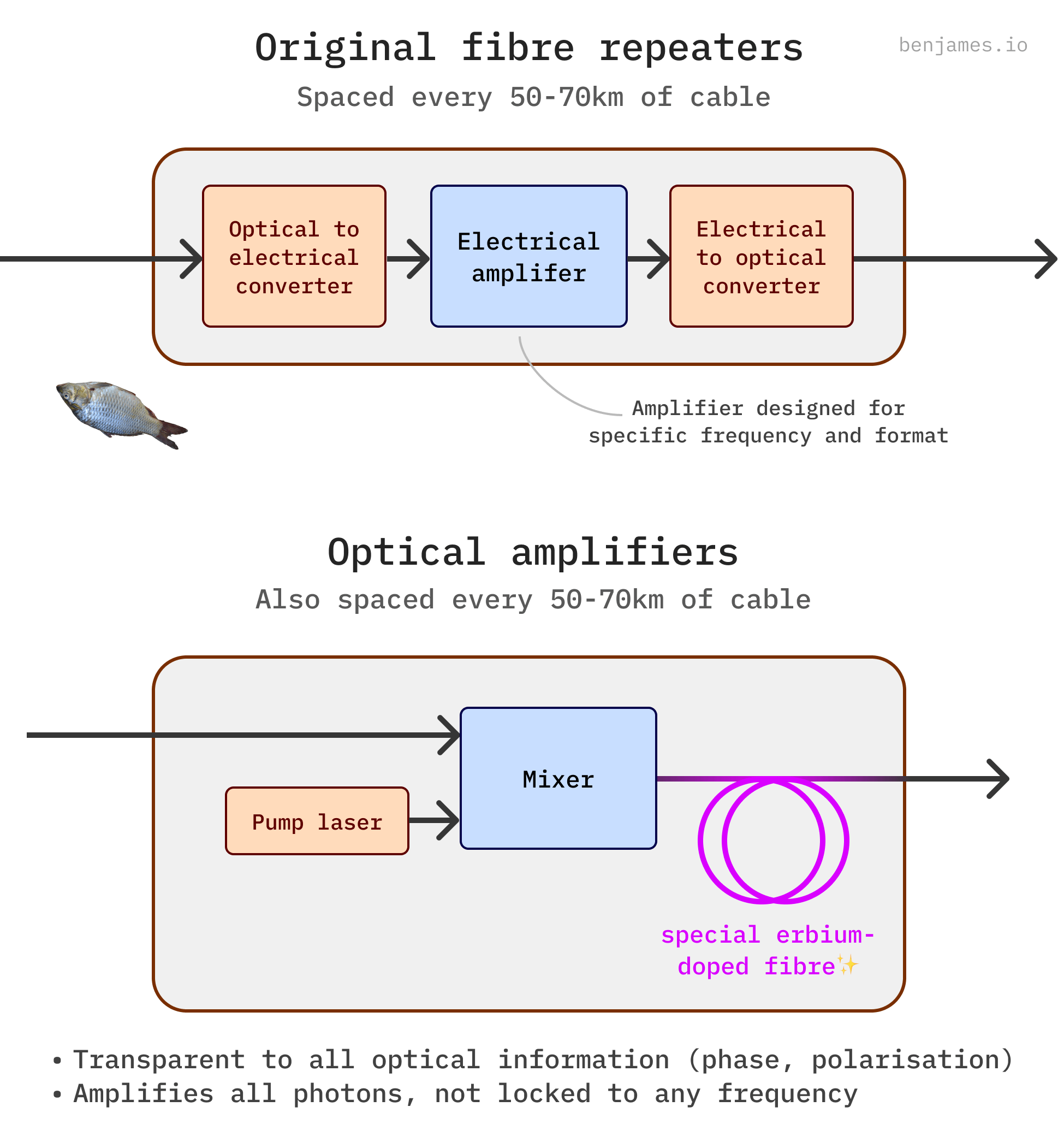
Basically, the optical amplifier uses a hype laser to energise a ton of ions in the Erbium-doped fibre so that they’re literally bursting to transmit your Dad’s 👍reaction. When the incoming signal arrives, it causes those ions to release their energy as photons, and the signal gets amplified.
Note: the internal laser needs power, so we still have to send electrical cables next to the fibre core to power these amplifiers. AT&T’s first fibre optic cable in the Canary Islands included no electromagnetic shielding, since the wires were only for powering amplifiers, not transmitting data. The cable was taken out of action by sharks several times, ostensibly due to the shark’s attraction to the electric field.
(unrelated shark vid just for fun)
Coherent optics
So, optical amplifiers pass on all the juicy light information, but we still need something to read it at the other end. That something is coherent optics, but it was a long time coming. It was not until 2008 that the first commercial receivers could read phase shifts at the end of a long fibre cable.
We need coherent optics for measuring phase shift because light moves too fast to measure it manually. Theoretically you could try to sample the peaks and troughs of a light wave, time the delay, and determine the phase shift. But light waves are just 2 fast 4 u. A laser at 1500nm is wiggling 200 trillion times per second, which is about a thousand times too fast for even the fastest chips today.
Coherent optics uses a different technique. Instead of sampling the incoming signal directly, you sample the interference of the incoming signal with a reference laser. The strength of this interference signal changes according to the phase shift and amplitude of the incoming signal.
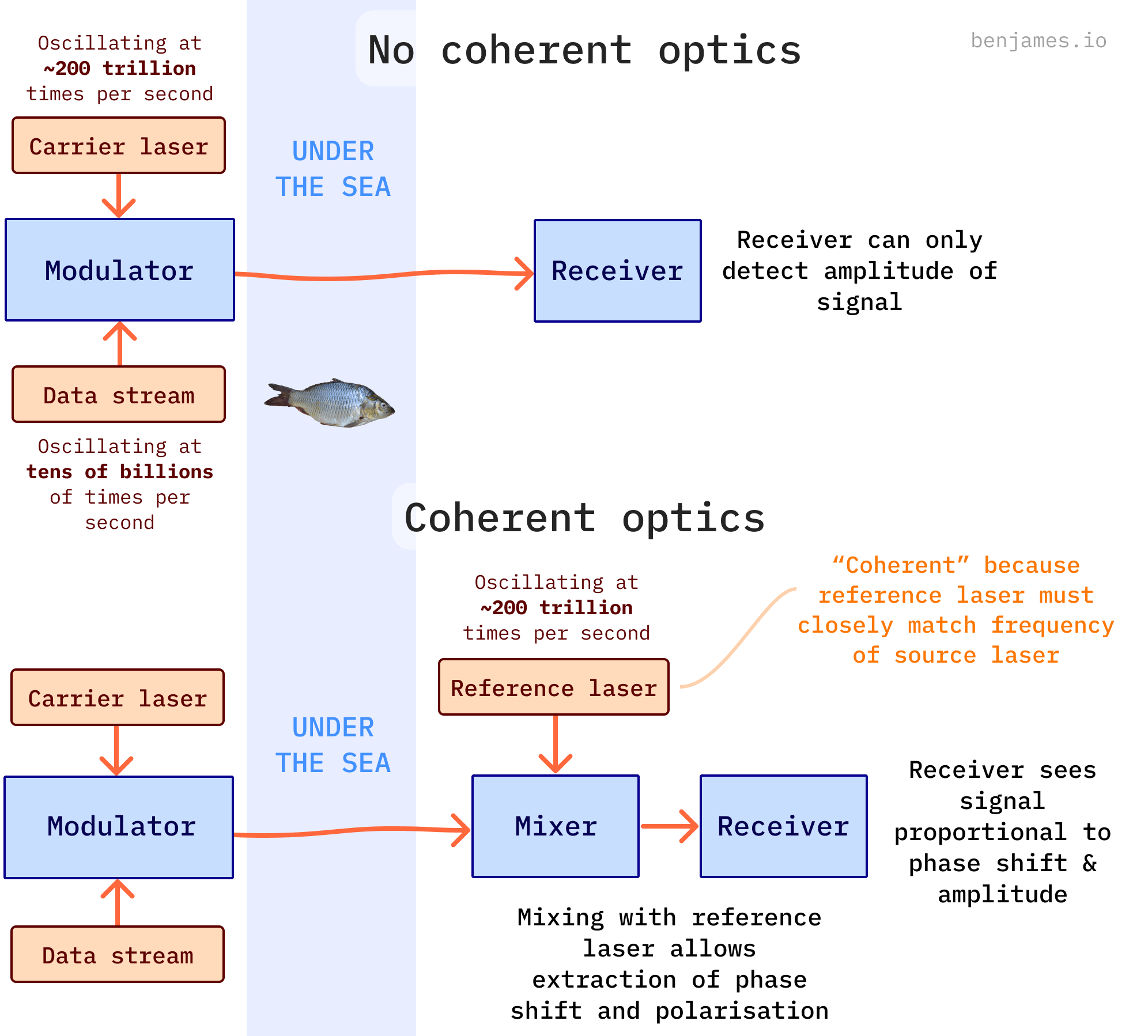
Coherent optics took so long because it was difficult to sync the reference laser to the carrier laser (they would always drift apart). If you remember our constellation diagram from earlier, you can imagine it rotating at the rate that the lasers are out of sync, which can be up to several hundred million times per second. We can electronically correct for this because it is still a glacial drift compared to the real data rate, in the tens of billions of times per second.
Putting it all together
A modern subsea fibre cable combines coherent optics, erbium amplifiers, wavelength division multiplexing, dual polarisation, amplitude-and-phase keying, faster silicon, and up to 24 fibre pairs per cable.
A recent cable like Anjana, laid by Meta in 2024, has enough capacity to carry roughly 8 billion simultaneous voice calls - approximately the world population speaking through one cable.
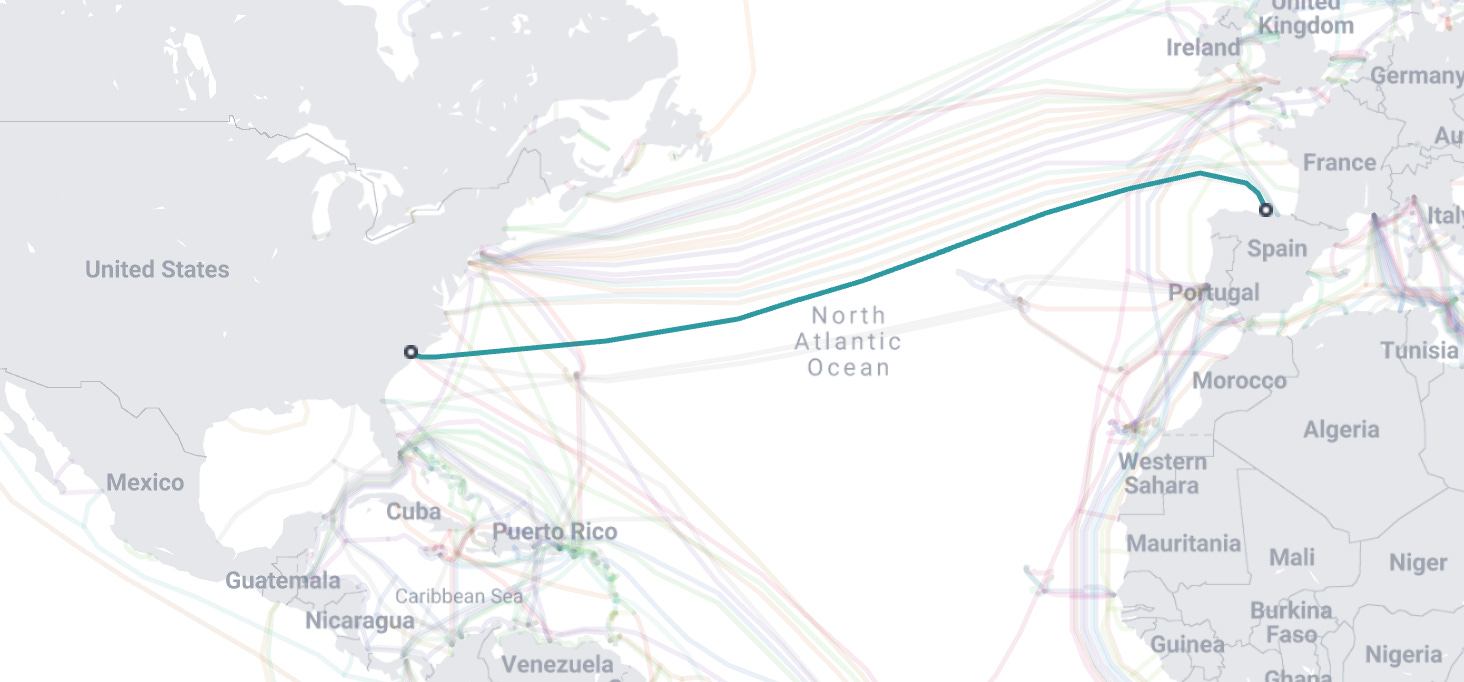
As of 2026, there are now 18 fibre optic cables crossing the Atlantic.
—
Thanks for reading - I haven’t done a techy piece in a while. DMs open as always for thoughts!
Ben
🦈
Love to have you back at writing tech pieces - they’re my fav (don’t get me wrong, still believe that we need desert innovation)